
MULTICYLINDER ENGINES | SPARK-IGNITION ENGINE OPERATION
- NILESH GUPTA
- Jan 20, 2021
- 8 min read

Updated: Jan 21, 2021
1.5 MULTICYLINDER ENGINES
Small engines are used in many applications: for example, lawn mowers,
chain saws, in portable power generation, as outboard motorboat engines,
and motorcycles. These are often single-cylinder engines. In the above
applications, simplicity and low cost in relation to the power generated are
the most important characteristics; fuel consumption, engine vibration, high
power to weight or volume ratio, and engine durability are usually less
important. A single-cylinder engine gives only one power stroke per
revolution (two-stroke cycle) or two revolutions (four-stroke cycle). Hence,
the individual cycle torque pulses are widely spaced, and engine vibration
and smoothness are significant issues.
Multi Cylinder configurations are invariably used in practice in all but the
smallest engines. As rated power increases, the advantages of smaller
cylinders in regard to bulk size, weight, improved engine performance, and
engine balance and smoothness all point toward increasing the number of
cylinders so the engine’s total displaced volume is spread out amongst
several smaller cylinders. The increased frequency of power strokes with
smaller and increasing number of cylinders produces more frequent and
smaller torque pulses, and thus smoother output. The forces in each
components are smaller, so structural design requirements are reduced.
Multi Cylinder engines can also achieve a much better state of balance than
single-cylinder engines. A force must be applied to each piston to accelerate
it during the first half of its travel from BC or TC. The piston then exerts a
force on the crankshaft as it decelerates during the second part of the stroke.
It is desirable to cancel these inertia forces through the choice of number and
arrangement of cylinders to achieve a primary balance. Note, however, that
the motion of the piston is more rapid during the upper half of its stroke than
during the lower half (a consequence of the connecting rod and crank
mechanism evident from Fig. 1.1; see also Sec. 2.2 ). The resulting inequality
in acceleration and deceleration of pairs of pistons (one moving up and one
moving down) produces corresponding differences in inertia forces
generated. Certain combinations of cylinder number and arrangement balance
out these secondary inertia force effects.
For a given engine displaced volume, the larger the number of cylinders,
the higher the engine’s maximum power. The reciprocating speed of an
The engine's pistons are limited by the airflow into each cylinder. Once the flow
through the intake valve becomes sonic—reaches the speed of sound—higher
piston speeds do not increase airflow. For a given engine displacement,
increasing the number of cylinders, and thus reducing their size, raises the
crankshaft rotational speed at which this sonic airflow limit is reached. Since
engine power is proportional to the engine’s rotational (crankshaft) speed,
maximum performance is improved.
Other operational issues are affected by cylinder size. The relative
importance of heat losses from the in-cylinder gases depends on the relative
importance of the combustion chamber surface area to its volume. The SI
engine compression-ratio limiting phenomenon called knock is adversely
affected by the flame travel distance (spark plug gap to farthest combustion
chamber wall).
Common four-stroke multi cylinder configurations are shown in Fig. 1.6. 13
These multi cylinder configurations normally use equal crankshaft rotation
firing intervals between cylinders. In in-line engines, the cylinders are
arranged in a single plane. Three-, four-, five-, and six-cylinder in-line
configurations are used. Four-cylinder in-line engines are the most common
arrangement for automobile engines from 1.2 to about 2.5-liter displacement.
An example of this in-line arrangement is shown in Fig. 1.4. It is compact—
an important consideration for small passenger cars. It provides two torque
pulses per revolution of the crankshaft, and primary inertia forces (though not
secondary forces) are balanced. Six-cylinder in-line diesel engines are
commonly used in the truck market with up to 12-liter displacement.
Figure 1.6 Multicylinder engine configurations: (1) In-line engine; (2) Vengine;
(3) Radial engine; (4) Opposed-cylinder engine; (5) U-engine; (6)
Opposed-piston engine.13 (Courtesy Robert Bosch GmbH and SAE.)
The vee (V) arrangement, with two banks of cylinders set at an angle to
each other, provides a compact engine block and is used extensively for
larger displacement automotive engines. Vee six, eight, ten, and twelve
configurations are used. In a V-6 engine, the six cylinders are arranged in two
banks of three, usually with a 60° angle between their axis. Six cylinders are
normally used in gasoline SI engines in the 2.4- to 3.6-liter displacement
range. Six-cylinder engines provide smoother operation with three torque
pulses per revolution. The in-line arrangement is fully balanced. However, it
gives rise to crankshaft torsional vibration, and also makes even distribution
of air to each cylinder is more difficult. The V-6 arrangement is more compact
than an in-line 6, and provides primary balance of the reciprocating
components. With the V-engine, however, a rocking moment is imposed on
the crankshaft due to the secondary inertia forces, which results in the engine
being less well balanced than the in-line version. The V-8 arrangement, in
sizes between 3.2 and 6 or more liters, is commonly used to provide
compact, smooth, low-vibration, larger-displacement, SI engines, as are V-
10 and V-12 designs.
The radial engine configuration, with cylinders arranged in one or more
radial planes, as shown, was common in larger piston-driven aircraft
engines. Opposed cylinder engine designs are occasionally used. As Fig. 1.6
indicates, the motion of pairs of pistons with this design is fully balanced.
The U-cylinder configuration, where the pistons move in the same direction,
and the opposed-piston configuration have been used in special purpose two stroke
engine concepts.
1.6 SPARK-IGNITION ENGINE OPERATION
In SI engines, the fuel must be vaporized and well mixed with the air
inducted into the cylinder, prior to combustion. Historically, the fuel flow
was metered with a carburetor or single-point fuel-injection system ( Fig.
1.7a) upstream of the throttle, which controls the airflow. This approach has
been superseded by intake-port fuel injection ( Fig. 1.7 b) where a pulsed
liquid fuel spray is directed toward the intake valve. Injection of gasoline
directly into each cylinder ( Fig. 1.7 c) is now in large-scale production.
Moving the point of fuel injection closer to the cylinder enables better
dynamic response during engine transients.
Figure 1.7 Different fuel-injection approaches for gasoline spark-ignition
engines. ( a) Single-point injection; ( b) Multipoint port injection; ( c) Direct in-cylinder injection. (1) Fuel supply; (2) Air supply; (3) Throttle valve; (4)
Intake manifold; (5) Injectors; (6) Engine. 13 ( Courtesy Robert Bosch GmbH
and SAE.)
Figure 1.8 shows the layout of a modern SI engine management system.
The airflow, fuel flow, exhaust gas characteristics, and engine operating state
are all monitored and controlled as shown to provide the desired engine
performance with good combustion characteristics, high efficiency, and low
exhaust air pollutant emissions. The ratio of mass flow of air to mass flow of
fuel must be held approximately constant at about 15 to ensure reliable
combustion and facilitate exhaust emissions control. The appropriate fuel
flow is determined for the engine airflow in the following manner. The
airflow into the intake system is measured with an air mass-flow meter. A
the throttle valve or plate, which can be opened or closed, controls the airflow.
The appropriate amount of fuel required per cylinder per cycle to generate
The desired engine output is then determined by the engine control unit. In
naturally-aspirated engines, the intake airflow is reduced by throttling to
below atmospheric pressure by reducing the flow area when the power
required (at any engine speed) is below the maximum, which is obtained
when the throttle is wide open.
Figure 1.8 Schematic of modern port-injected engine management system
(Bosch ME-Motronic system). (1) Carbon fuel-vapor absorbing canister; (2)
Hot-film air-mass meter with integrated temperature sensor; (3) Throttle
device; (4) Canister-purge valve; (5) Intake-manifold pressure sensor; (6)
Fuel-distribution pipe; (7) Injector; (8) Actuators and sensors for variable
valve timing; (9) Ignition coil with attached spark plug; (10) Camshaft phase
sensor; (11) Lambda oxygen sensor upstream of primary catalytic converter;
(12) Engine control unit; (13) Exhaust-gas recirculation valve; (14) Speed
sensor; (15) Knock sensor; (16) Engine-temperature sensor; (17) Primary
three-way catalytic converter; (18) Lambda oxygen sensor downstream of
primary catalytic converter: (19) CAN interface; (20) Fault lamp; (21)
Diagnosis interface; (22) Interface to immobilizer control unit; (23)
Accelerator-pedal module with pedal-travel sensor; (24) Fuel tank; (25) Intank
unit with electric fuel pump, fuel filter, and fuel-pressure regulator; (26)
Main three-way catalytic converter. 13 ( Courtesy Robert Bosch GmbH and
SAE.)
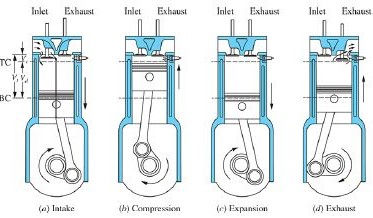
The sequence of events that take place inside the engine cylinder is
illustrated in Fig. 1.9. Several variables are plotted against crank angle
through the entire four-stroke SI engine cycle. Crank angle is a useful
independent variable because the various engine processes occupy almost
constant crank angle intervals over a wide range of engine-operating
conditions. The figure shows the valve opening and closing angles, and
volume relationship, for a typical fixed valve-timing automotive SI engine.
To maintain high mixture flows at high engine speeds (and thus high power
outputs) the inlet valve, which opens before TC, closes substantially after
BC. During intake, the inducted fuel and air mix in the cylinder with the
residual burned gases remaining from the previous cycle. After the intake
valve closes, the cylinder contents are compressed to above atmospheric
pressure and temperature as the cylinder volume is reduced. Some heat
transfer between the in-cylinder gases and the piston, cylinder head, and
cylinder walls occur—first a heating of the gases, then a cooling, but the effect
on unburned gas properties is modest.
Figure 1.9 Sequence of events in four-stroke spark-ignition engine operating
cycle. Cylinder pressure p (solid line, firing cycle; dashed line,
motored cycle), cylinder volume V/V max, and mass fraction burned xb are
plotted against crank angle.
Between about 10 and 40 crank angle degrees before TC, an electrical
discharge across the spark plug starts the combustion process. Before the
desired ignition point, the ignition driver switches a current to the primary
circuit of the ignition coil. At the ignition point, the primary winding is
interrupted, generating in the secondary ignition coil winding that is
connected to the spark plug, a high voltage across the plug electrodes as the
magnetic field collapses. This switching is done electronically. A flame
develops from the spark discharge, propagates through the mixture of air,
fuel, and residual gas in the cylinder, and extinguishes at the combustion
chamber walls. The duration of this burning process varies with engine
design and operation, but is typically 40 to 60 crank angle degrees, as shown
in Fig. 1.9. As fuel-air mixture burns in the flame, the cylinder pressure
(solid line in Fig. 1.9) rises above the level due to compression alone
(dashed line). This latter curve—called the motored cylinder pressure—is
the pressure trace obtained from a motorized or non firing engine. f Note that
due to differences in the flow pattern and mixture composition between
cylinders and within each cylinder, cycle-by-cycle, the development of each
the combustion process differs somewhat. As a result, the shape of the pressure
versus crank angle curve in each cylinder, and cycle-by-cycle, is not exactly
the same.
There is an optimum spark timing which, for a given mass of fuel, air, and
residual inside the cylinder, gives maximum torque. More advanced (earlier)
timing or retarded (later) timing than this optimum gives lower output. Called
maximum brake-torque (MBT) timing, g this optimum timing is an empirical
compromise between starting combustion too early in the compression stroke
(when the work transfer is to the cylinder gases) and completing combustion
too late in the expansion stroke (and so lowering peak expansion stroke
pressures).
About two-thirds of the way through the expansion stroke, the exhaust
the valve starts to open. The cylinder pressure is significantly higher than the
exhaust manifold pressure and a blowdown process occurs. The burned gases
flow through the valve into the exhaust port and manifold until the cylinder
pressure and exhaust pressure equilibrate. The duration of this process
depends on the pressure level in the cylinder. The piston then displaces most
of the remaining burned gases from the cylinder into the manifold during the
exhaust stroke. The exhaust valve opens before the end of the expansion
stroke to ensure that the blowdown process does not last too far into the
exhaust stroke when the piston travels upwards. The actual timing is a
compromise that balances reduced work transfer to the piston before BC
against reduced work transfer to the cylinder contents after BC.
The exhaust valve remains open until just after TC; the intake opens just
before TC. The valves are opened and closed slowly to avoid noise and
excessive cam wear. To ensure the valves are fully open when piston
velocities are at their highest, the valve open periods usually overlap
somewhat. If the intake flow is throttled to below exhaust manifold pressure,
then backflow of burned gases from the cylinder into the intake manifold
occurs when the intake valve is first opened. During the valve overlap
period, backflow of burned gas from the exhaust port into the cylinder
occurs.
With variable valve control, the trade-offs that fixed valve timing requires
can be relaxed. The simplest approach varies intake and exhaust valve timing
by rotating the camshafts to change their phasing relative to the crankshaft.
More complex systems vary valve lift as well as varying the valve opening
and closing angles. Variable valve control is attractive because it improves
maximum engine power (at high speed) and maximum torque at lower
speeds, and can improve part-load engine efficiency. It can also be used to
control the mass of burned residual gas, and fresh air, trapped in the engine
cylinder.


Comments